

Moisture Sensing Yarns Market Enters Commercial Scale, Set to Reach USD 1.1 Bn by 2036 | Future Market Insights, Inc.
Moisture Sensing Yarns Market Size
Healthcare adds demand as Heathcoat’s absorbent viscose wound-care fabric launches in 2025, enabling sensing-ready textiles and 10.9% CAGR growth.
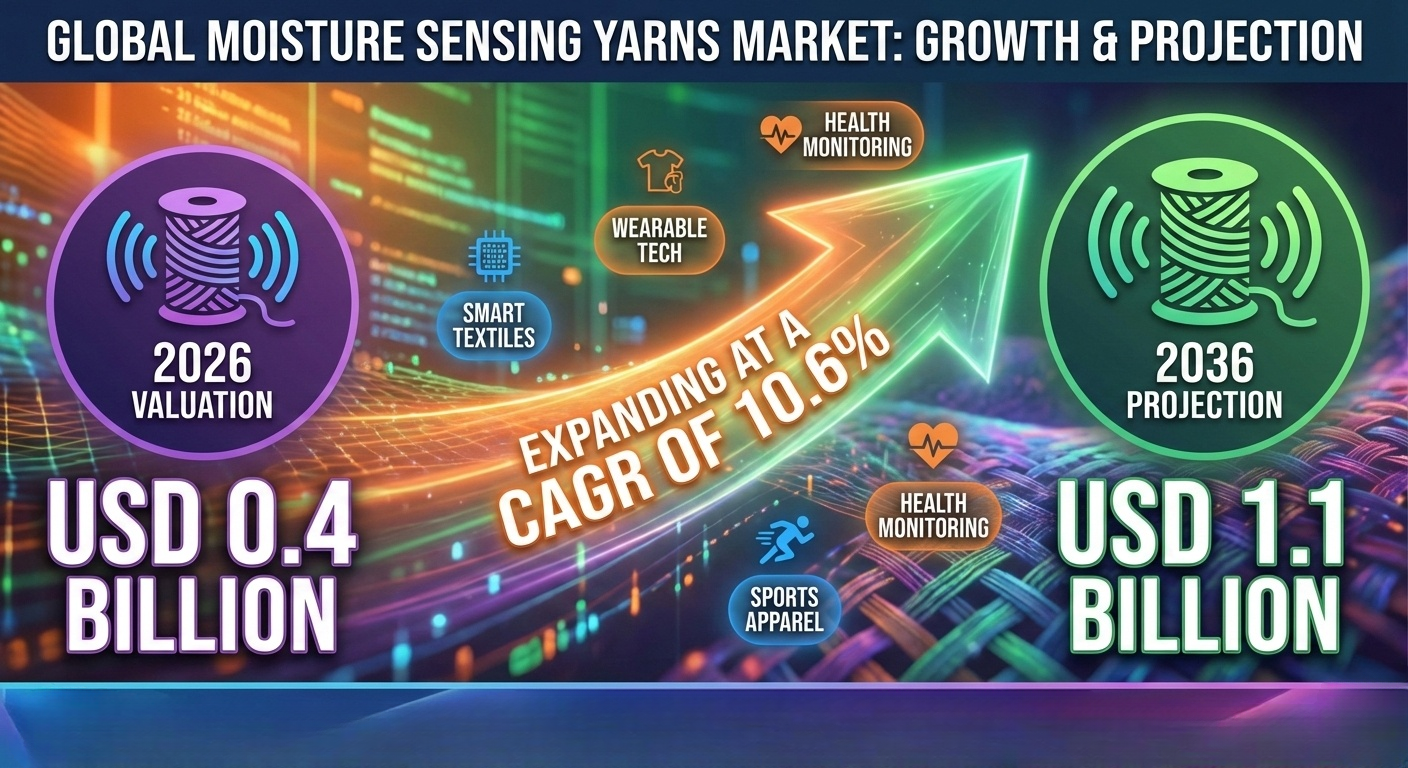
NEWARK, DE, UNITED STATES, February 6, 2026 /EINPresswire.com/ -- The global moisture sensing yarns market is entering a decisive commercialization phase, moving beyond pilot demonstrations toward qualification-led procurement across apparel, hygiene, and medical textiles. Valued at USD 0.4 billion in 2026, the market is projected to reach USD 1.1 billion by 2036, expanding at a compound annual growth rate (CAGR) of 10.6%, according to analysis by Future Market Insights (FMI).
This growth reflects a fundamental shift in buyer logic. Brands and institutions no longer debate whether yarns can register moisture; instead, procurement decisions now hinge on whether sensing performance survives laundering, abrasion, repeated bending, and garment assembly without signal drift or connector failure. As a result, durability evidence and qualification readiness are becoming the primary determinants of scale adoption.
Explore Opportunities – Get Your Sample of Our Industry Overview Now!
https://www.futuremarketinsights.com/reports/sample/rep-gb-31811
From Demonstration to Procurement: What Is Driving the Market
Moisture sensing yarns are functional yarn systems engineered to detect or respond to moisture and humidity changes within textile structures using resistive, capacitive, humidity-reactive, or hybrid mechanisms. Their commercial relevance is increasing as unmanaged moisture creates measurable downstream costs—ranging from higher return rates in sportswear to skin breakdown in hygiene products and labor-intensive interventions in healthcare.
FMI’s demand projections are built using bottom-up revenue modeling, cross-application adoption weighting, and procurement interviews focused on wash-cycle retention and lifecycle reliability. These inputs indicate that moisture sensing is transitioning from a comfort feature to a risk-management input where total cost of ownership, rather than unit garment cost, governs purchasing decisions.
Technical Focus Shifts to Wash Resistance and Interconnect Stability
Recent patent filings and qualification discussions highlight a consistent technical bottleneck: interconnect points between conductive yarns and external electronics. These interfaces remain the most common failure locations in wearable systems. Filings associated with Hexoskin, for example, emphasize connector geometry, strain relief, and contact stability reflecting lessons learned from deployed garments rather than laboratory prototypes.
At the same time, the market is structurally splitting into two architectural paths:
• Passive structural solutions, where fiber cross-section design and yarn geometry manage moisture through capillary action or swelling effects. These approaches prioritize manufacturability and wash endurance and are associated with suppliers such as Teijin and Toray.
• Active electrically assisted systems, including electro-osmotic or low-voltage actuation mechanisms that actively transport moisture. These architectures, linked to Myant, target clinical, protective, and tactical applications where moisture accumulation affects skin integrity or operational readiness.
This divergence is not temporary; it reflects distinct cost, durability, and qualification trade-offs that now guide sourcing strategies.
Standards Act as Market Filters
Verification requirements are tightening alongside technical differentiation. In the United States, IPC-8911 establishes benchmarks for durability and sensing repeatability in wearable textile systems. In Europe, EN 17666:2025 strengthens electrical resistance measurement protocols for conductive tracks, directly affecting moisture sensing yarn layouts.
Compliance with these frameworks favors suppliers capable of repeatable testing, controlled material variation, and documented failure analysis. As a result, sourcing is increasingly concentrating around vertically integrated manufacturers with established qualification infrastructure, while smaller suppliers face higher barriers to entry.
Market Outlook by Application and Geography
By 2036, FMI expects the largest value pools to form in sports apparel, hygiene textiles, and medical fabrics, where moisture awareness becomes commercially relevant when it reduces returns, prevents adverse outcomes, or offsets labor and care costs.
Key application and adoption dynamics include:
• Sports and fitness apparel (36% share): Sweat is frequent and measurable, allowing moisture sensing to translate into perceived product quality and repeat purchase behavior.
• Incontinence and hygiene textiles: Wetness detection supports better change timing and skin integrity outcomes.
• Medical and wound care textiles: Moisture and exudate monitoring reduces labor-intensive dressing changes and enables earlier intervention.
Geographically, the United States holds the largest share by value, anchored by qualification leadership under IPC-8911 and defense-linked procurement pathways. China follows with scale-driven manufacturing aligned to industrial policy, while Germany, the UK, and Japan each show growth shaped by high-assurance technical textiles, funded validation pathways, and premium fiber engineering, respectively.
Key Market Metrics
• Market Value (2026E): USD 0.4 billion
• Forecast Value (2036F): USD 1.1 billion
• CAGR (2026–2036): 10.6%
• Leading Sensing Mechanism: Resistive-based architectures (40% share) due to manufacturability-to-reliability balance
Competitive Landscape: Qualification Capacity Becomes the Differentiator
The competitive environment changed materially in 2026 as buyers moved away from experimental demonstrations toward evidence-based procurement. Supplier differentiation is no longer centered on detection capability alone, but on the ability to document sustained performance after laundering, mechanical cycling, and long-term use under standardized conditions.
Market behavior increasingly separates into two operating models:
• Utility-grade platforms that treat moisture sensing as infrastructure, emphasizing durability, documentation, and integration discipline.
• Outcome-driven systems that justify higher pricing where unmanaged moisture creates immediate clinical or operational risk.
Regulated markets add further screening layers. Hexoskin’s FDA 510(k) clearance in late 2025 established a reference pathway for garment-based monitoring systems, while defense applications highlight the role of three-dimensional textile architectures, such as Heathcoat Fabrics’ DRYTEC, in managing moisture-driven thermal stress.
Why FMI: https://www.futuremarketinsights.com/why-fmi
Have a Look at Related Research Reports on the Healthcare Domain:
Lubricant Market https://www.futuremarketinsights.com/reports/lubricants-market
Plastic Market https://www.futuremarketinsights.com/reports/plastic-market
Battery-Integrating Textile Current Collector Yarns Market https://www.futuremarketinsights.com/reports/battery-integrating-textile-current-collector-yarns-market
RF-Shielding Fiber Yarns Market https://www.futuremarketinsights.com/reports/rf-shielding-fiber-yarns-market
About Future Market Insights (FMI)
Future Market Insights, Inc. (FMI) is an ESOMAR-certified, ISO 9001:2015 market research and consulting organization, trusted by Fortune 500 clients and global enterprises. With operations in the U.S., UK, India, and Dubai, FMI provides data-backed insights and strategic intelligence across 30+ industries and 1200 markets worldwide.
Sudip Saha
Future Market Insights Inc.
+1 347-918-3531
email us here
Legal Disclaimer:
EIN Presswire provides this news content "as is" without warranty of any kind. We do not accept any responsibility or liability for the accuracy, content, images, videos, licenses, completeness, legality, or reliability of the information contained in this article. If you have any complaints or copyright issues related to this article, kindly contact the author above.
