

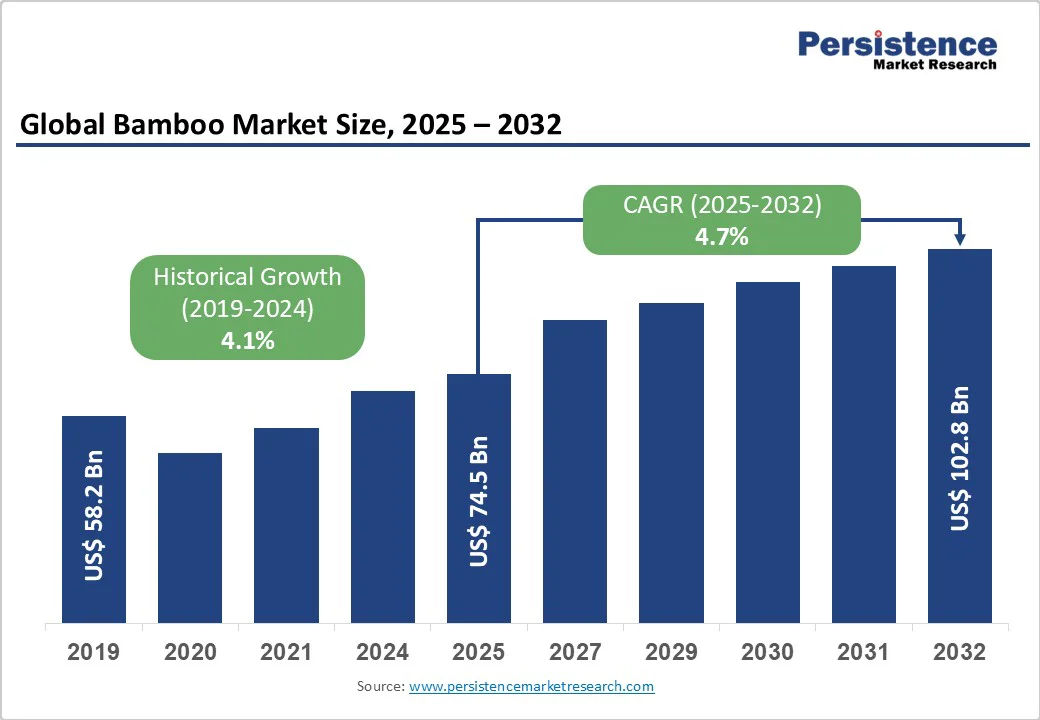
Bamboo Market Size Growth from US$74.5 Billion in 2025 to US$102.8 Billion by 2032
bamboo market
Raw bamboo is projected to dominate the market with a 60% share in 2025, supported by widespread availability, strong supply chains
LONDON, LONDON, UNITED KINGDOM, March 16, 2026 /EINPresswire.com/ -- The global bamboo market is gaining strong momentum as industries increasingly adopt sustainable and eco friendly raw materials. Bamboo is widely recognized for its fast growth, high strength, and versatile applications across construction, textiles, furniture, packaging, and energy sectors. Its natural renewability and ability to regenerate without replanting make it an attractive alternative to traditional wood and synthetic materials. As sustainability becomes a priority for governments, manufacturers, and consumers, bamboo based products are witnessing rising demand worldwide.
According to the latest study by Persistence Market Research, the global bamboo market size is likely to be valued at US$74.5 billion in 2025 and is projected to reach US$102.8 billion by 2032, growing at a CAGR of 4.7 percent from 2025 to 2032. Increasing awareness about environmental conservation, the shift toward biodegradable materials, and the growing use of bamboo in modern construction and interior design are some of the major factors driving market expansion.
Download Your Free Sample & Explore Key Insights : https://www.persistencemarketresearch.com/samples/35731
Rising Demand for Sustainable Materials
Sustainability is one of the most important factors influencing the growth of the bamboo market. As industries seek alternatives to resource intensive materials such as hardwood, plastic, and metal, bamboo has emerged as a reliable and environmentally responsible option. Bamboo grows significantly faster than most timber species and absorbs large amounts of carbon dioxide, making it beneficial for climate change mitigation. Many manufacturers are incorporating bamboo into eco friendly product lines such as biodegradable packaging, sustainable furniture, and renewable textiles. Consumers are also showing a preference for natural materials that support environmentally conscious lifestyles. These trends are expected to continue driving bamboo adoption across various industries.
Expanding Applications Across Multiple Industries
Another major growth factor for the bamboo market is its expanding application range. Bamboo can be used in both raw and processed forms to create a wide variety of products. In construction and infrastructure projects, bamboo is used as a structural material due to its strength, flexibility, and lightweight properties. In interior design, bamboo flooring and decorative panels are gaining popularity for their aesthetic appeal and durability. The furniture and home décor industry is another significant user of bamboo materials. Bamboo furniture offers a natural appearance and long lifespan while supporting sustainable sourcing practices. Additionally, bamboo fibers are increasingly used in the textile and apparel industry to produce soft and breathable fabrics that appeal to environmentally conscious consumers.
Customize This Report for Your Exact Requirements : https://www.persistencemarketresearch.com/request-customization/35731
Market Segmentation
The bamboo market can be understood through several key segments that highlight its diverse applications and product types.
By Bamboo Type
•Raw Bamboo
•Processed Bamboo
By Application
•Construction & Infrastructure
•Flooring & Interior Design
•Furniture & Home Décor
•Paper & Pulp Industry
•Textiles & Apparel
•Food & Beverages
•Energy & Fuel
•Packaging & Composites
•Misc.
By Region
•North America
•Europe
•East Asia
•South Asia Oceania
•Latin America
•Middle East & Africa
Regional Market Insights
East Asia remains one of the largest markets for bamboo due to its long tradition of bamboo cultivation and utilization. Countries such as China have developed extensive bamboo processing industries that supply global markets with flooring, furniture, and textile products. Government support for bamboo cultivation and export oriented manufacturing further strengthens the region’s market leadership.
South Asia and Oceania are also important regions for bamboo production and consumption. Countries in this region benefit from favorable climatic conditions for bamboo cultivation and growing domestic demand for sustainable construction materials. Latin America and Africa are emerging markets where bamboo is increasingly recognized as a resource for rural development, housing, and renewable energy.
In North America and Europe, the bamboo market is driven by sustainability trends and increasing demand for eco friendly consumer products. Bamboo based flooring, furniture, and textiles are gaining popularity among environmentally conscious consumers and businesses seeking sustainable alternatives.
Technological Advancements in Bamboo Processing
Technological innovation is playing a key role in the development of the bamboo market. Modern processing techniques allow manufacturers to convert raw bamboo into high performance engineered materials that can compete with traditional construction products. Laminated bamboo boards, composite panels, and bamboo fiber textiles are examples of value added products that are expanding market opportunities. These advancements also improve product durability, consistency, and scalability, enabling bamboo products to meet international quality standards. As technology continues to evolve, bamboo based materials are expected to penetrate new industrial sectors including automotive interiors, advanced composites, and eco friendly packaging.
Checkout Now & Download Complete Market Report : https://www.persistencemarketresearch.com/checkout/35731
Company Insights
✦ Moso International BV
✦ Shanghai Tenbro Bamboo Textile Co. Ltd
✦ Dasso Industrial Group Co. Ltd.
✦ Cali Bamboo
✦ Tengda Bamboo Wood Co. Ltd.
✦ Higuera Hardwoods LLC
✦ Kerala State Bamboo Corporation
✦ Epitome bamboowood products Mutha Industries
✦ EcoPlanet Bamboo Group
✦ Guadua Bamboo
✦ Zhejiang Senhe Bamboo and Wood Co. Ltd
✦ Bamboo India Pvt Ltd
These companies play a crucial role in expanding bamboo applications across construction, textiles, furniture, and consumer goods industries while promoting sustainable material solutions.
Future Outlook of the Bamboo Market
The outlook for the bamboo market remains highly positive as industries continue to prioritize sustainability and renewable resources. Governments and environmental organizations are promoting bamboo cultivation as a way to support rural economies, reduce deforestation, and encourage green building practices. Rising demand for eco friendly materials in construction, packaging, textiles, and furniture will likely drive further investment in bamboo processing technologies and product innovation. As awareness of bamboo’s environmental and economic benefits grows, the global market is expected to expand steadily through 2032 and beyond. In summary, bamboo is evolving from a traditional raw material into a modern industrial resource that supports sustainable development across multiple sectors. With increasing demand for renewable materials and continued technological progress, the bamboo market is poised for long term growth and global expansion.
Explore More Related Reports :
Tea Tree Oil Market
Athleisure Market
Persistence Market Research
Persistence Market Research Pvt Ltd
+1 646-878-6329
email us here
Visit us on social media:
LinkedIn
Instagram
YouTube
X
Legal Disclaimer:
EIN Presswire provides this news content "as is" without warranty of any kind. We do not accept any responsibility or liability for the accuracy, content, images, videos, licenses, completeness, legality, or reliability of the information contained in this article. If you have any complaints or copyright issues related to this article, kindly contact the author above.
