

Silk Market Set to Reach USD 38.7 Billion by 2035 as Premium Textiles and Sustainable Innovation Expand
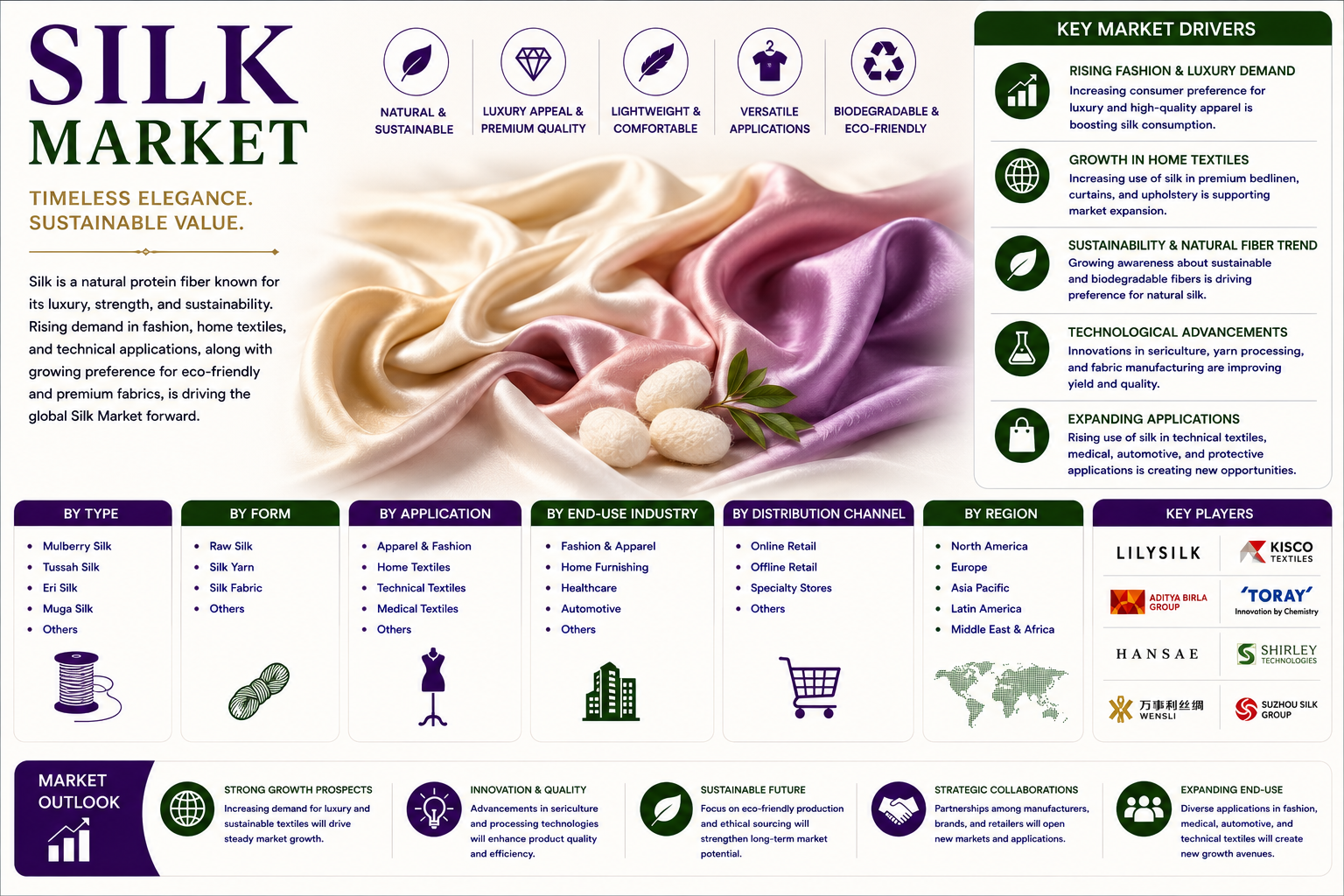
Silk Market
Asia Pacific dominates the Silk Market, reaching USD 4.39B by 2035 from USD 3.81B in 2024, while South America and MEA show steady growth
BEIJING , CHILE, August 26, 2026 /EINPresswire.com/ -- The Silk Market is undergoing a significant transformation as traditional silk production increasingly intersects with sustainability, technological advancement, premium fashion, home décor, cosmetics, and emerging medical applications. Silk remains highly valued for its softness, natural luster, strength, breathability, and luxurious appearance. At the same time, changing consumer preferences are encouraging producers to adopt more responsible farming and manufacturing practices. According to Market Research Future, the global Silk Market was valued at USD 20.8 billion in 2024 and is estimated to reach USD 22 billion in 2025. The market is projected to reach USD 38.7 billion by 2035, registering a 5.80% CAGR during the forecast period from 2025 to 2035.Sustainable Production Becomes a Defining Market Trend
Sustainability is increasingly influencing the direction of the Silk Market. Consumers are becoming more conscious of environmental and ethical considerations when purchasing luxury textiles, encouraging brands and producers to focus on responsible sourcing and production.
Silk manufacturers are exploring farming and manufacturing practices that can reduce environmental impact while maintaining the quality associated with premium silk. Interest in ethically sourced silk is also creating opportunities for producers that can demonstrate responsible supply chains and sustainable production methods.
The movement toward eco-friendly silk is not limited to raw material production. Textile processing, dyeing, water use, and waste management are also receiving greater attention. As sustainability becomes increasingly important to luxury brands, silk producers that combine premium quality with responsible production practices can strengthen their market position.
Fashion Industry Remains the Core Demand Center
The Fashion Industry remains the largest end-use segment of the Silk Market. Silk's elegant appearance, smooth texture, natural sheen, and excellent draping qualities make it a preferred material for luxury apparel and high-value fashion products.
Designers continue to incorporate silk into contemporary collections, while renewed interest in vintage and retro fashion is creating additional demand. Fashion shows and industry events also help maintain silk's premium image and influence consumer preferences.
The increasing purchasing power of consumers in emerging economies is another factor supporting luxury textile demand. As more consumers seek premium apparel and sophisticated fashion products, silk can benefit from the growing preference for high-quality natural materials.
Request Free Sample Copy: https://www.marketresearchfuture.com/sample_request/8464
Home Furnishings Create New Growth Opportunities
The Home Furnishings segment is emerging as a significant growth opportunity. Consumers are increasingly investing in sophisticated interior spaces and premium decorative materials, creating demand for silk curtains, cushions, upholstery, and other home-textile products.
Silk's distinctive texture and luxurious appearance make it attractive for high-end residential and commercial interiors. Interior designers can use silk to create visually distinctive spaces, particularly where premium aesthetics are a priority.
This expansion into home décor is strategically important because it broadens silk's application base beyond apparel. Growing interest in interior design and luxury home environments is expected to create additional opportunities for silk manufacturers and textile brands.
Silk Fabric Dominates Product Demand
By product type, Silk Fabric holds the largest share of the market. Silk fabric is extensively used across fashion, luxury apparel, home furnishings, and other textile applications because of its versatility, softness, luster, and premium characteristics.
Silk Threads and Silk Yarns are also important components of the industry, serving as essential materials for garment production, textile manufacturing, crafts, and other applications.
Meanwhile, Silk Dyes represent an emerging opportunity, particularly as manufacturers increasingly explore sustainable textile-processing solutions. Organic and biodegradable dyeing technologies are gaining attention as brands and consumers become more environmentally conscious.
The development of more sustainable dyeing processes could therefore contribute to the broader transformation of the silk value chain.
Purchase Now: https://www.marketresearchfuture.com/checkout?currency=one_user-USD&report_id=8464
Mulberry Silk Retains Market Leadership
Among silk types, Mulberry Silk continues to dominate the market. It is valued for its softness, strength, smooth texture, and consistent quality, making it particularly suitable for luxury garments and high-end textiles.
Its established production systems and widespread consumer acceptance reinforce its leading position. Premium fashion and textile manufacturers continue to rely heavily on Mulberry Silk where quality and appearance are key purchasing considerations.
Tasar Silk is the fastest-growing silk type, benefiting from increasing consumer interest in sustainable and eco-friendly textile options. Its distinctive texture and association with artisan and traditional textile production are helping it gain greater attention among consumers seeking differentiated and responsibly sourced products.
Cosmetics Opens an Emerging Application Avenue
Although fashion remains the dominant end-use sector, Cosmetics is the fastest-growing end-use segment. Silk proteins and extracts are increasingly being incorporated into skincare and beauty products because of their perceived nourishing and moisturizing properties.
Growing consumer interest in natural and premium cosmetic ingredients is encouraging brands to explore silk-derived ingredients in specialized formulations. This trend demonstrates the potential for silk to move beyond conventional textile applications.
Medical applications also represent an emerging opportunity. Technological research into bioengineered silk is creating possibilities for high-performance materials and healthcare products, potentially expanding the industry's long-term addressable market.
Technology Enhances Silk Production and Product Innovation
Technological advancement is reshaping the Silk Market by improving production efficiency, quality, and product diversity. Automated weaving and dyeing technologies can help manufacturers improve consistency while reducing production costs.
Research into synthetic alternatives and bioengineered silk is another important area of innovation. These technologies could enable manufacturers to develop materials with specialized characteristics for textiles, medical products, and other advanced applications.
The integration of technology with traditional sericulture is therefore creating a hybrid industry in which established silk production methods coexist with modern manufacturing and material-science approaches.
Report Summary: https://www.marketresearchfuture.com/reports/silk-market-8464
Asia-Pacific Provides Significant Expansion Potential
The Silk Market has a strong regional presence across Asia-Pacific, Europe, North America, South America, and the Middle East and Africa. North America remains the largest market, supported by robust demand for luxury textiles. The region was valued at approximately USD 1.52 billion in 2024 and is projected to reach USD 1.87 billion by 2035.
Europe represents another important silk-consuming region, with its market estimated at USD 2.95 billion in 2024 and projected to reach USD 3.34 billion by 2035. The region benefits from established luxury fashion and premium textile industries.
Asia-Pacific is identified as the fastest-growing region, reflecting its importance in silk production as well as increasing interest in sustainable and eco-friendly practices. The regional market was valued at approximately USD 3.81 billion in 2024 and is expected to reach USD 4.39 billion by 2035.
Competitive Landscape
The Silk Market includes companies such as SILK, SILK ROAD TEXTILES, SILK WEAVERS, SILK & CO., SILK TRADING CO., SILK FASHION, SILK HOUSE, and SILK PRODUCTION. Competition is increasingly shaped by product quality, sustainability, technological capabilities, design, and supply-chain management.
Companies are exploring sustainable production methods, innovative silk products, improved processing technologies, and partnerships with fashion and other end-use industries. Bioengineered silk is also creating new competitive possibilities as companies seek applications beyond traditional textiles.
Future Outlook for the Silk Market
The Silk Market is projected to grow from USD 22 billion in 2025 to USD 38.7 billion by 2035, representing a 5.80% CAGR. Rising demand for luxury textiles, sustainable production practices, fashion integration, home décor applications, and technological innovation will remain important growth factors.
The future of the industry will increasingly depend on the ability of producers to combine silk's traditional premium qualities with modern sustainability expectations. Home furnishings, cosmetics, sustainable silk varieties, and bioengineered materials offer additional avenues for diversification.
Overall, the combination of luxury consumption, sustainable sourcing, fashion innovation, technological advancement, and expanding applications is expected to support continued development of the global Silk Market through 2035.
Related report
US Silk market https://www.marketresearchfuture.com/reports/us-silk-market-21293
silk textile market https://www.marketresearchfuture.com/reports/silk-textile-market-32563
sustainable fashion market https://www.marketresearchfuture.com/reports/sustainable-fashion-market-30916
Textile Fabrics Market https://www.marketresearchfuture.com/reports/textile-fabrics-market-8231
Smart Textile Market https://www.marketresearchfuture.com/reports/smart-textile-market-5477
Market Research Future
Market Research Future
+1 855-661-4441
email us here
Legal Disclaimer:
EIN Presswire provides this news content "as is" without warranty of any kind. We do not accept any responsibility or liability for the accuracy, content, images, videos, licenses, completeness, legality, or reliability of the information contained in this article. If you have any complaints or copyright issues related to this article, kindly contact the author above.
