

City Council Committee on Sanitation and Solid Waste Management Oversight Hearing: Waste Valorization and the Circular Economy
Good afternoon, Chair Sanchez and thank you for holding this hearing today. I am representing Brooklyn Borough President Antonio Reynoso. While the topic of waste valorization is important, we are concerned that the City Council has not scheduled a hearing on DSNY’s Final Solid Waste Management Plan (SWMP). The Council is expected to approve this plan by the State’s October deadline and has broad oversight on its content. Stakeholders would appreciate the opportunity to formally weigh in again on final changes needed before this document guides our city’s waste policy for the next decade.
That said, Borough President Reynoso’s main concern with finalizing the SWMP is operationalizing the City’s commitment to improving our diversion rate. Keeping waste from landfills has multiple benefits: it lessens the environmental burden that we impose on communities inside and outside the city, brings down export costs, decreases emissions from truck trips and landfilled organic waste, and lessens the amount of non-biodegradable waste that stays in the environment.
The City’s diversion rate increased slightly to 19.4% as of the most recent Mayor’s Management Report (MMR), yet it remains below the City’s stated goal in the MMR of 23%, below the national average of about 32% (per EPA), and well below the City’s codified goal of sending zero divertible waste to landfills by 2030 (per Local Law 87 of 2023). Additionally, DSNY is setting itself up for an even lower diversion rate by failing to include recycling and organics in its new, citywide, on-street containerization program for large buildings. DSNY’s own Future of Waste report recommended including bin space for all three types of waste in on-street containers, and DSNY is now rolling out three-section bins at schools. Yet the agency intends to use landfill-bound-trash-only bins for the citywide rollout. Studies show that making source separating recycling and organics as simple as possible leads to higher diversion, and this complicated system is likely to have the opposite effect.
Reducing waste sent to landfills must also include keeping material from becoming waste in the first place. Extended Producer Responsibility (EPR) laws are critical, and we appreciate DSNY’s support of these policies. Additionally, the SWMP notes that our capture rate for textiles is only about 5.5%, and the average NYC household disposes of about 92 pounds of textile waste per year, according to DSNY’s own data. Councilmember Hudson’s Intro 256 is a smart step toward expanding textile recycling in the city. Again, making recycling as easy as possible is key, and not every New Yorker has access to a textile recycling bin in their basement or is going to haul their old clothing to a farmer’s market.
Waste reduction is particularly critical for food waste, which is the most significant contributor of waste-related greenhouse gas emissions. EPA’s Wasted Food Scale, shown below, illustrates the importance of food donation, and we commend DSNY for committing to continue its DonateNYC program. However, this platform is underutilized and needs more outreach and education attached to really be impactful.
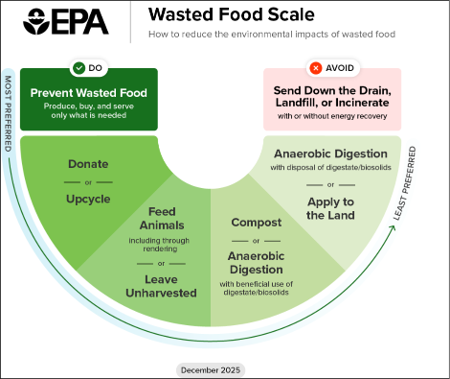
Source: https://www.epa.gov/sustainable-management-food/sustainable-management-food-graphics
Another important element of the Wasted Food Scale is the preference for compost or anaerobic digestion “with beneficial use” over anaerobic digestion with disposal or land application. Our report, Expanding Composting in New York City, the Case for Passing and Implementing Intro 369-2026, goes into detail about why traditional composting methods are preferable over co-digestion. Co-digestion increases the production of toxic biosolids and contributes to the expansion of fossil-fuel infrastructure. While DEP has expressed its intention to achieve 100% beneficial use of biosolids, almost all biosolids are currently landfilled, and achieving beneficial use is becoming more challenging as states regulate their use due to the presence of PFAS, also known as “forever chemicals.”
Importantly, Local Law 85 of 2023 requires DSNY to “include a plan to maximize the usable composting of organic waste collected” in the 2026 SWMP. The 2026 Draft and Final SWMP noted that DSNY recovered 73% of separated organics collected “for beneficial use”; however, this calculation includes co-digestion. Per the law, the Final Plan must “describe the amount of organic waste collected and sent to composting facilities to be processed into usable compost” (emphasis added). We encourage DSNY to revisit this and make this number public.
Another important waste stream where DSNY can increase reuse and recycling is Construction & Demolition (C&D). This makes up more than 60% of the city’s solid waste, so it is positive that the SWMP considers reuse of C&D materials. Much of the waste generated by C&D projects can be recycled or reused, including carpet, scrap lumber, steel, concrete, and ceiling tiles. We suggest creating new legislation to require developers to submit a waste management plan requiring a certain amount of diversion per project in order to receive a demolition permit.
Finally, we want to address an important land use component of the SWMP. As the Final report notes: “The shrinking of manufacturing zones with vacant parcels has made it more challenging to site waste infrastructure.” DSNY should begin collaboration with DCP to ensure that future plans include sufficient space to support such facilities in all five boroughs, including compost operations, special waste collection, sanitation garages, remanufacturing/upcycling, etc.
Thank you again for holding this hearing today. We again encourage the Council to take a hard look at the SWMP and advocate to strengthen it with the intention of making New York City a worldwide leader in waste reduction, recycling, and reuse.
Legal Disclaimer:
EIN Presswire provides this news content "as is" without warranty of any kind. We do not accept any responsibility or liability for the accuracy, content, images, videos, licenses, completeness, legality, or reliability of the information contained in this article. If you have any complaints or copyright issues related to this article, kindly contact the author above.
